A protobuf decoder, one optimization at a time
How the decoders got fast: seven optimizations, re-enabled one at a time and measured. Back to the README; the maintained numbers live in benchmarks.md.
RapidProto is a code generator that turns protobuf schemas into C++ decoders - an arena decoder that materializes a whole message tree, and a streaming decoder that hands each field to a callback. Both ended up fast, but “fast” arrived one change at a time, and some of these optimizations are quite interesting. This article tries to go through a few of them, explain them, and show the impact they have.
How these numbers were made
What is measured is the generated decoder’s throughput divided by a reference decoder’s throughput on the same bytes in the same binary: protoc (libprotobuf 4.25.3) for arena benchmarks, protozero for streaming benchmarks. A step’s change on a benchmark is shown in the charts only when it exceeds that benchmark’s own measured noise.
The suite mixes synthetic sweeps (packed varints, zigzag, enums), record shapes, and real
payloads - a mixed-record Dataset, Google’s two reference messages, and OSM PBF blocks.
One caveat: everything here was produced at one point in time (one revision, clang 20, September 2026); the maintained numbers are in benchmarks.md.
The baseline
The starting point is the decoder a careful first implementation would produce. One loop per message: read a tag, switch on the field number, decode the value into the struct, validate everything on the way. Repeated fields append to a geometrically growing array. Varint readers have a 1-byte fast path. Strings are copied. The compiler inlines whatever it feels like.
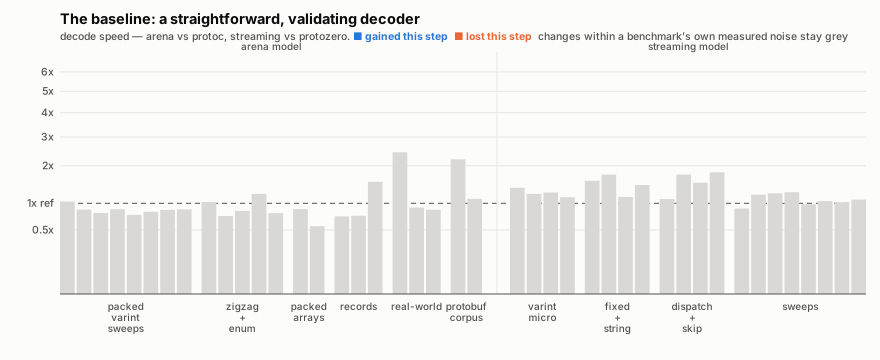
With all of that, the arena baseline decodes Dataset at 2.4× protoc - and the streaming
baseline ranges from 0.9× protozero on the 1-byte varint sweep to 1.8× on sparse-skip.
Step 1: borrowed strings
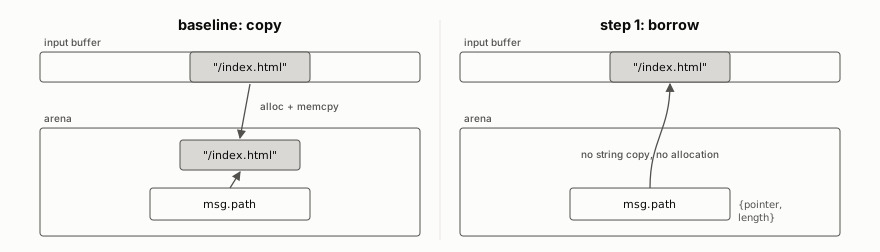
A decoded string does not need its own bytes - the input buffer already has them. The arena stores every string and bytes field as a {pointer, length} view into the input: no copy, no allocation, no small-string optimization to branch on.
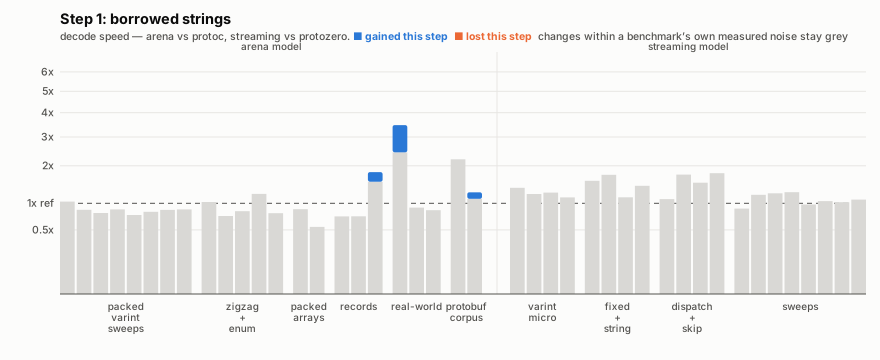
Dataset is string-heavy and gains ×1.42; google_message2 gains ×1.14 and
many msgs, tiny arrays ×1.18. Arena memory for
Dataset drops from 1.23 MB to 1.03 MB - against protoc’s 1.97 MB for the same payload.
The streaming side is unaffected by construction: its API has handed out string_views from
the beginning.
Step 2: packed pre-sizing
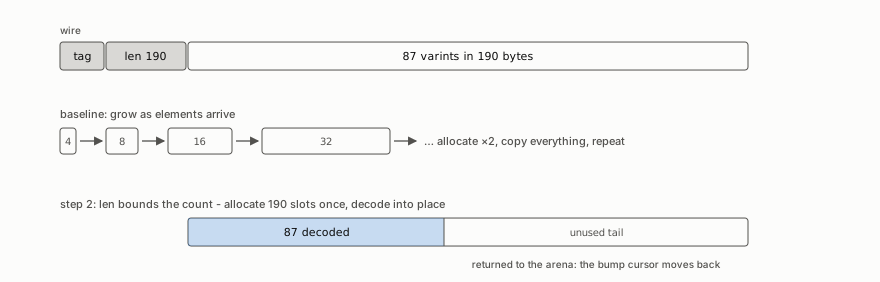
A packed repeated field arrives length-prefixed, and the length says a lot. For fixed-width elements it gives the exact element count; for varints it bounds the count from above (each element is at least one byte). So instead of growing an array element by element, the decoder allocates the bound once, decodes into place, and returns the unused tail to the arena - the trim just moves the arena’s bump cursor back, since nothing else allocated in between.
For fixed-width elements on a little-endian machine there is a second consequence: the wire
span already is the array’s byte image, so the whole fill is one memcpy. That is how
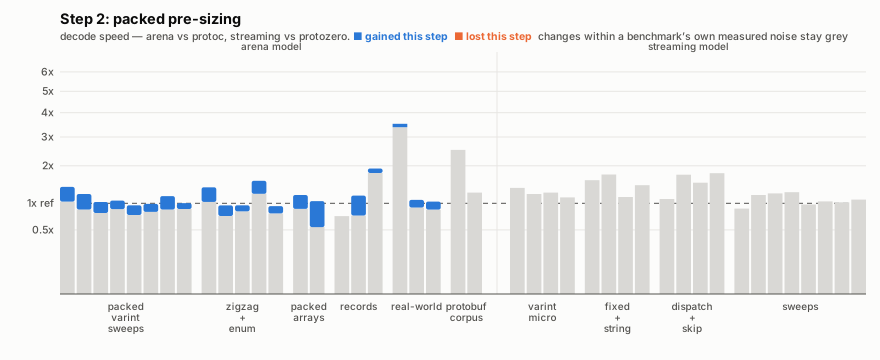
packed double gains ×1.93. The varint sweeps gain ×1.14-1.4 from the pre-sizing alone, and
few msgs, big arrays gains ×1.57. Twenty benchmarks speed up on this step, none slow
down. The streaming decoder passes each value to a callback, so there is no array to
pre-size and it stays where it was.
Step 3: forced inlining
The decode loop calls small wire primitives constantly - read a varint, read a length, skip
a value. RP_FLATTEN (gcc and clang’s flatten attribute) tells the compiler to inline
the entire call tree into each generated decode function, and it turns out compilers are
far too conservative, clang included: without the attribute, per-element read helpers stay
out of line and the cursor round-trips through calls.
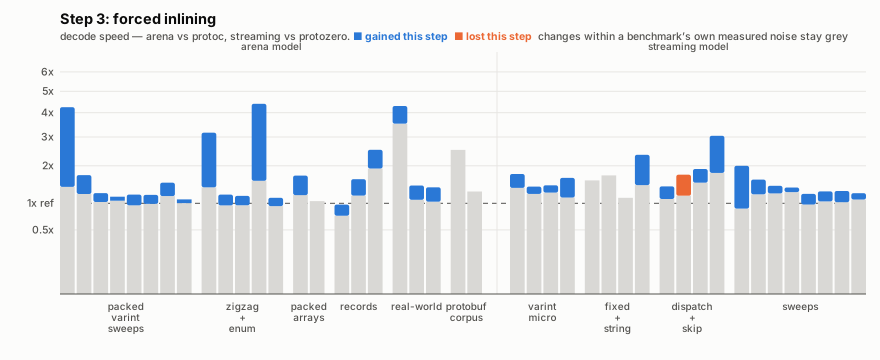
This is the broadest optimization step - 36 benchmarks improve. The all-1-byte varint sweep
gains ×3.04, the streaming version of the same sweep gains ×2.25 (crossing protozero here for
the first time), and sparse-skip gains ×1.71 because the skip helpers now inline too.
Two costs. First, unbounded flattening would inline entire sub-message decoders into their
parents, so a custom layout planner marks large decoders as inline barriers - flatten inside,
never inline into parent. Second, one regression: the nesting-heavy streaming nested-msg benchmark
falls to 0.68× of its previous speed on this step and never recovers; flattening a recursion-heavy shape can make it
worse. Compile time and code size also pay for this step; the shipped build’s compile costs
are tracked in benchmarks.md.
Step 4: fused tag reads
Decoding every field starts with the same three questions: is the buffer done, is the next varint a valid tag, what field is it. Asking them separately means two bounds checks per field. The fused read answers all three from one bounds check, returning end, tag, or error in a single step - and inside it, a tag byte below 128 short-circuits: field number and wire type fall out of one byte with a shift and a mask.
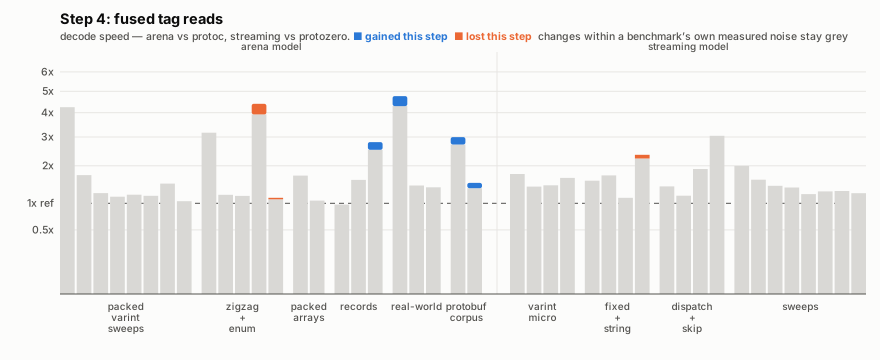
The gains concentrate where fields are small and plentiful: Dataset +11%,
google_message1 +10%, google_message2 +10%, many msgs, tiny arrays +11%. Two enum
sweeps lose ground, rv-enum fx1 by 11% and rv-enum mix13 by 3%, and the streaming
mixed benchmark reads 5% slower.
Step 5: SWAR varint kernels
In the builds so far, a packed repeated varint is decoded one byte at a time: read a byte, test the continuation bit, read the next byte if it is set. This is inherently sequential, and on mixed-width data branch prediction cannot help much - the mispredictions hurt a lot.
One idea is to have dedicated decoders (so-called kernels) for various value distributions. A kernel loads 64 bits at a time and tries to decode multiple varints in parallel, optimizing for a specific distribution. The high bit of each byte marks continuation, a multiply-and-shift gathers those eight bits into a mask, and three shift-and-mask rounds compact each value’s 7-bit groups into a contiguous result. One branch for the whole 64-bit word now replaces one branch per byte.
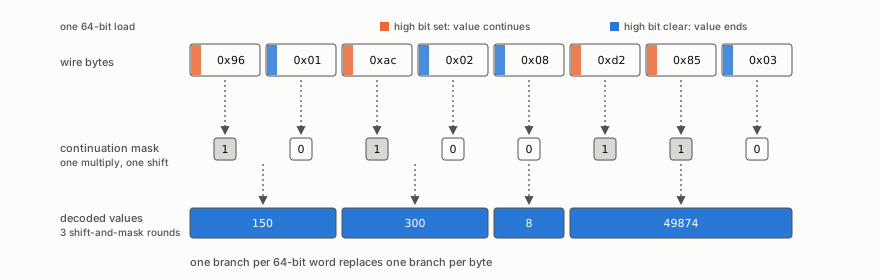
This requires, of course, that the decoder properly predicts the distribution: it probes the first 64 bytes of each span and picks the kernel to match. As this adds overhead it only makes sense for larger payloads (in our case 256+ bytes).
The kernels are written in a portable fashion - no SIMD intrinsics, just basic integer instructions, a technique called SWAR (SIMD within a register) - but often compile into SIMD instructions anyway.
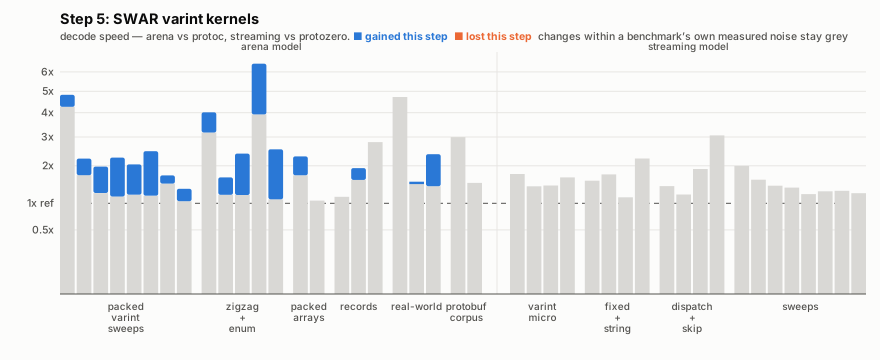
The all-1-byte sweep (rv fx1) gains 13% - its continuation bit never varies, so the branch
it lost was a predicted one. The multi-byte and mixed sweeps gain the most: ×2.33 on the
enum mix, ×1.96 on the all-10-byte sweep, ×1.29 on uniformly random widths. The streaming
side stays unaffected: that decoder hands each value to a callback as
it is decoded, and without a bulk fill the kernels remain unused.
Step 6: the one-byte peek hub
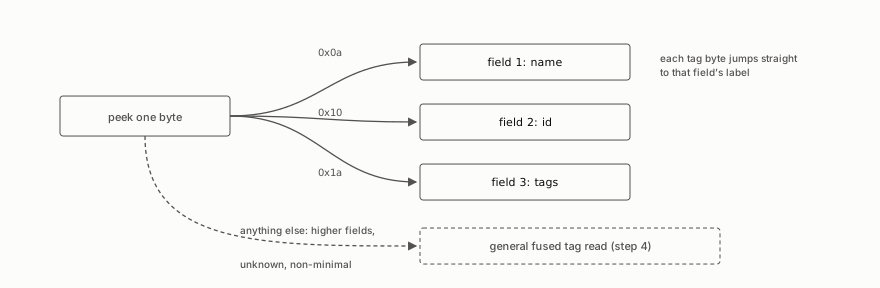
Fields numbered 1 through 15 have single-byte tags, and most messages live entirely in that range. So before doing a full tag read, the loop peeks at the raw byte and switches on it directly - each known tag byte jumps straight to a label that decodes that field, tag already consumed. Anything else (higher fields, unknown fields, a non-minimal encoding) falls through to the general path from step 4, unchanged.
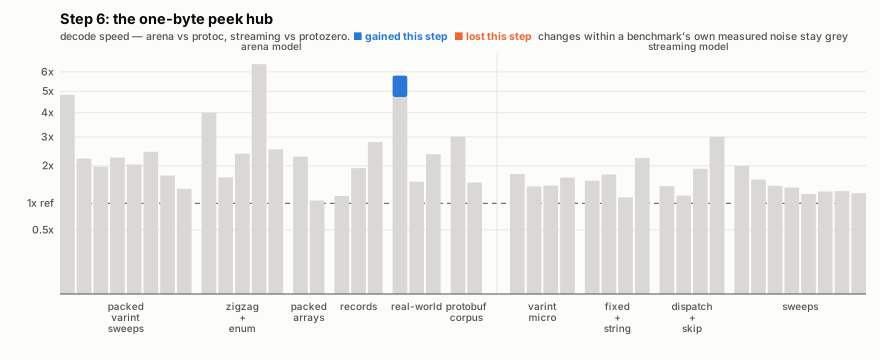
A single benchmark moves on this step, but it is Dataset, the suite’s mixed real-world
payload, at ×1.23. Elsewhere a switch on a byte is still a switch. The hub’s second job is
structural - it turns each field’s decode into an addressable label, and labels are what the
next step needs.
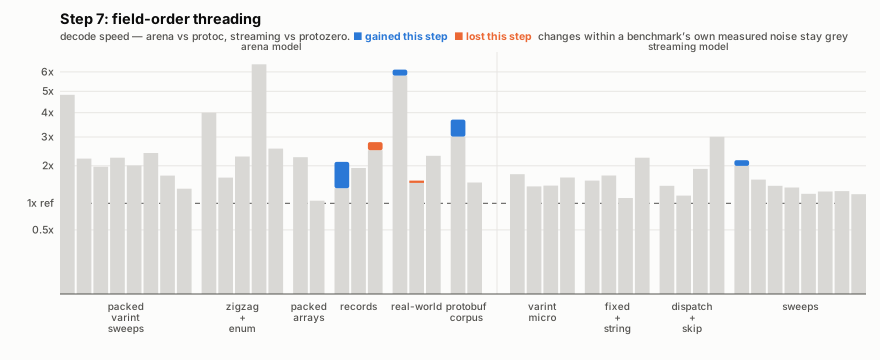
Step 7: field-order threading
Encoders write fields in ascending field-number order - protoc does, and the spec recommends it. That makes the next tag predictable: after field 3, expect field 4 or 5. So each field’s label ends by comparing the next byte against the constant tags of the next two expected fields, and jumping straight to the matching field’s label. A repeated field checks for another element of itself first. A oneof’s siblings are skipped - at most one member occurs. On an in-order wire the decoder becomes a chain of direct, mostly correctly predicted branches; the dispatch switch from step 6 only catches the exceptions.
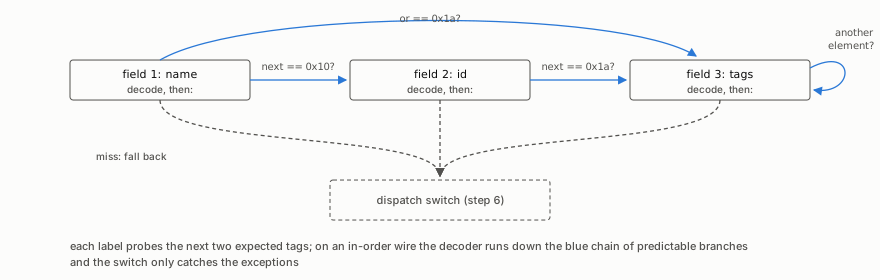
The dispatch-bound benchmark gains ×1.56, google_message1 ×1.23, the streaming 1-byte
sweep picks up 9%, and Dataset finishes at 6.1× protoc. Two benchmarks lose ground:
osm_blocks -4% and many msgs, tiny arrays -10%. Their fields often arrive in an order
the probes do not expect, and each miss adds a failed comparison before the dispatch switch
takes over.